
March 16, 2026

This is the final post in “The Research Behind the Story,” a six-part series exploring how award-winning historical fiction writers use travel and on-location research to create the novels we love.
We’ve spent five posts talking about what research travel can do. Now let’s talk about what it looks like — not in the abstract, but day by day, in a specific place, for a specific writer with a specific novel to write.
Let’s say you’re working on a novel. Your protagonist is a young Zapotec woman in 1920s Oaxaca, navigating the collision between indigenous tradition and post-Revolution Mexico. You’ve done your desk research — read Elena Garro’s Recollections of Things to Come, studied the post-Revolution period, pored over Zapotec history and the political upheaval that reshaped rural Mexico. You have your character. You have your plot. What you don’t have is the world she moves through.
You don’t know what the light looks like at six in the morning in the Central Valleys. You don’t know how the air smells in a market where chocolate is being ground and chilis are being roasted ten feet apart. You don’t know how far it is from the valley floor to the ruins your character’s grandmother tells stories about, or what it feels like to stand on a mountaintop that was a city before Rome was built.
So you go to Oaxaca.
Here’s what that week might look like.
You land in Oaxaca City and the first thing you notice is the color. Not the color of the buildings, though the colonial center is a wash of green cantera stone and terracotta and faded yellow — but the color of the light. It’s different here than anywhere you’ve been. The city sits at 5,000 feet in a valley ringed by the Sierra Madre, and the altitude does something to the quality of the air that makes shadows sharper and colors more saturated. You’ll try to describe this later, at your desk. You won’t be able to. But your body will remember it, and it will show up in your prose.
Your hotel is in the historic center, a few blocks from the Zócalo — the main plaza that has been the center of public life here since the Spanish founded the city in 1529 on a site the Zapotec had already been using for centuries. You walk the streets that evening and notice the grid pattern the Spanish imposed on the Zapotec settlement, the way the buildings are low and thick-walled — adapted to earthquakes, not aesthetics, though the effect is beautiful. You notice the sound. Music from three directions. Voices carrying differently off stone than they do off wood or glass.
You sit in the Zócalo with a notebook and write down everything you observe. This is not sightseeing. This is calibration — resetting your senses to a place your character knows intimately and you’re encountering for the first time.
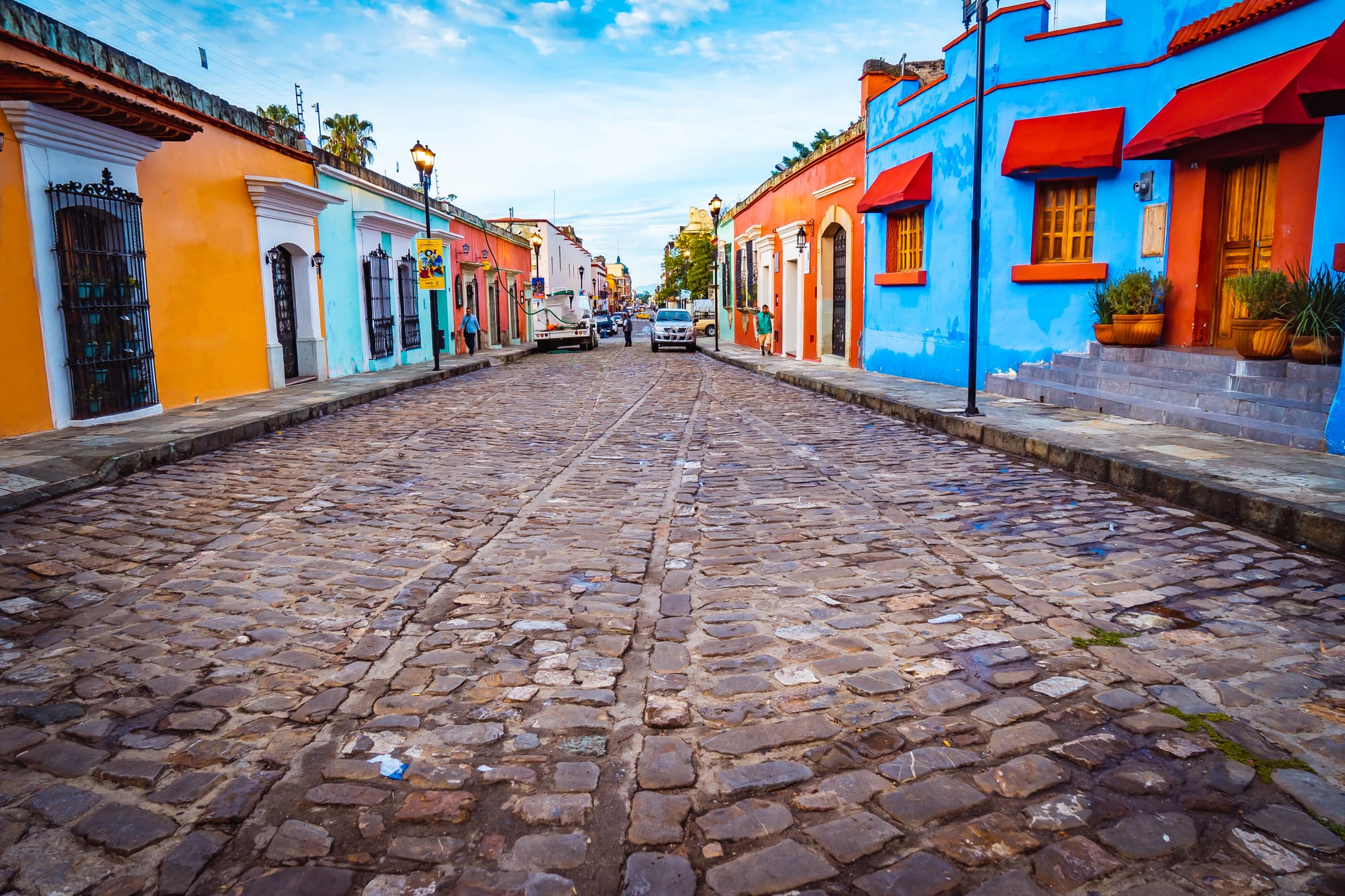
Street view in Oaxaca City
Your character’s grandmother tells stories about the old city on the mountain. In your novel, these stories carry the weight of a culture that predates the Spanish by two thousand years. You’ve read about Monte Albán. You’ve seen photographs. You think you understand it.
You don’t.
The drive from the city takes twenty minutes, climbing a winding road through dry scrub until the road crests and the ancient city opens before you — a vast ceremonial plaza, 300 meters by 200, carved into the top of a mountain at 6,400 feet. The Zapotec didn’t build on this mountain. They made this mountain into a city, leveling the ridgeline, constructing terraces and pyramids and temples from the stone itself.
The scale is the first shock. Photographs flatten it. Standing on the North Platform and looking south across the Main Plaza, you understand viscerally that this was a place designed to make human beings feel the presence of something larger than themselves. Fifteen thousand people could gather in this plaza. The acoustics are extraordinary — a voice carries across stone in ways that feel engineered, because they were.
The second shock is the silence. Not absence of sound — there are birds, wind, other visitors — but a quality of quiet that comes from being above the valley, removed from the world below. Your character’s grandmother would have known this silence. It would have meant something to her that it can’t mean to a tourist. That distinction — between visiting a ruin and inheriting a legacy — is something you’ve been trying to write. Standing here, you begin to understand the difference in your bones.
You spend three hours. You photograph the carved stone figures called the Danzantes — some of the earliest writing in the Americas. You visit the site museum and study the funerary urns, the gold jewelry from Tomb 7, the evidence of a civilization that maintained a written language and astronomical observatory while Europe was still in its early centuries. You take notes not on facts but on feelings — the heat of the stone underfoot, the way the valley looks from above, the distance between this mountaintop and the city below.
You’ll use all of it.
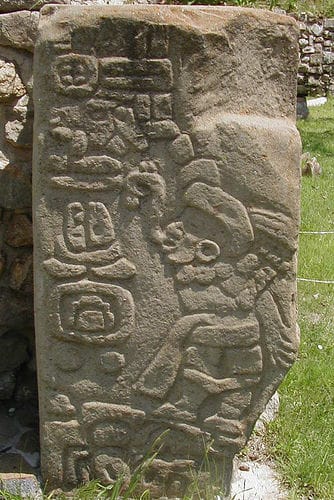
Carved stones at Monte Albán. Public domain, via Wikimedia Commons
Your novel lives in the tension between two worlds — the indigenous Oaxaca that existed for millennia and the Spanish colonial order imposed on top of it. Today you go looking for the seam between them.
The Church of Santo Domingo de Guzmán is the place where that seam is most visible. Built by Dominican friars between 1575 and 1731 using indigenous labor, it’s a baroque masterpiece — gold leaf ceiling, elaborate stucco work, a family tree of the Dominican order rendered in plaster and paint that covers the entire ceiling of the nave. It’s breathtaking and it’s also a record of cultural domination, built by the hands of the people whose civilization it was designed to replace.
The adjoining former convent now houses the Museo de las Culturas de Oaxaca, and this is where your research day gets its spine. Fourteen galleries spanning pre-Hispanic through modern Oaxacan history, including the treasures from Monte Albán’s Tomb 7 — gold masks, turquoise mosaics, carved bones so intricate they look like lace. You spend an hour in the gallery covering the period between Monte Albán’s decline around 900 CE and the Spanish conquest, because this is the era your character’s grandmother mythologizes. The Mixtec reuse of Zapotec tombs. The fragmentation of political power across the valley. The rise of Mitla as a religious center. The slow transformation of a unified civilization into something more fractured and vulnerable.
In the ethnobotanical garden behind the museum, you find plants that have been cultivated in this valley for thousands of years — agave, cacao, maize, copal. Your character would have known these plants the way you know the trees in your own backyard. You write down their shapes, their smells, the way the garden is laid out to show continuity between ancient cultivation and modern life.
That evening, you eat mole negro at a restaurant near the market. Seven types of chili, chocolate, plantain, avocado leaf, burned tortilla — a dish that takes three days to make and that has been made in this valley, with variations, for centuries. You’re not eating for pleasure, though it is extraordinary. You’re eating for research. Your character’s mother makes this. You need to know what it tastes like.
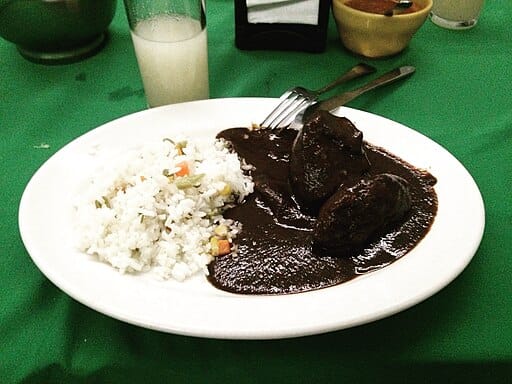
Mole Negra con Arroz. Photo by ProtoplasmaKid, CC BY-SA 4.0, via Wikimedia Commons
Today you leave the city and drive into the Tlacolula Valley, the eastern arm of the three valleys that converge at Oaxaca City. This is the landscape your character inhabits — not the tourist center, but the working countryside where Zapotec culture isn’t preserved in museums but is still being lived.
Your first stop is Teotitlán del Valle, a weaving village where Zapotec families have been producing textiles on backstrap and pedal looms for generations. You watch a weaver work with cochineal dye — the deep red pigment that comes from crushing insects that live on prickly pear cactus, and that was once so valuable the Spanish guarded its source as a state secret. Your character’s family might have done this work. The rhythm of the loom, the smell of wet wool and natural dye, the patience required — these are sensory details that don’t exist in any book you’ve read.
At the Tlacolula market — if you’ve planned your trip to include a Sunday — you walk through a sprawl of color and noise that has been operating in some form since the Mesoamerican period. Women in traditional Zapotec embroidery sell chapulines (dried grasshoppers), homemade mezcal, chocolate, pan de muerto. Live turkeys. Hand-forged knives. Woven baskets. The market isn’t a cultural exhibit. It’s a living economic system that connects your character’s world to the present day.
Then Mitla — the “Place of the Dead,” the Zapotec religious capital that rose after Monte Albán’s decline. Where Monte Albán overwhelms with scale, Mitla astonishes with precision. The geometric stone mosaics that cover its walls are made from thousands of individually cut and fitted pieces of stone, no two panels identical. Fourteen distinct geometric patterns, each with cosmological significance, assembled without mortar. A Spanish colonial church sits directly on top of part of the site — literally built on the foundations of the Zapotec sacred buildings. The layering is not subtle. For your novel, it’s perfect.
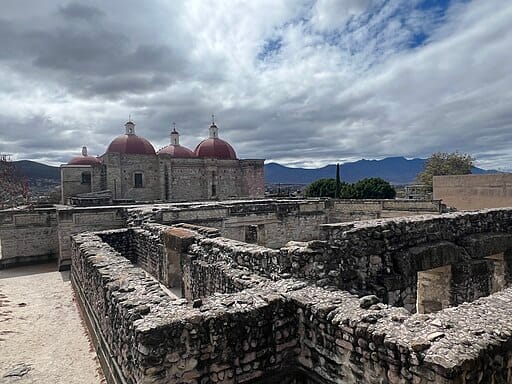
The archaeological site of Mitla is located in the state of Oaxaca. Photo by WendyAvilesR, CC BY 4.0, via Wikimedia Commons
This is the day you don’t plan. Every good research trip needs one.
Maybe you go back to something that nagged at you — a street in the historic center where the buildings change character, a sound you heard near the market that you couldn’t identify, a view from a rooftop that reminded you of something your character would see. Maybe you sit in a café and write for four hours. Maybe you talk to a mezcal producer in Santiago Matatlan — the self-declared world capital of mezcal, forty-five minutes down the valley — and learn that the production process hasn’t fundamentally changed in centuries, that the knowledge passes through families the way your character’s grandmother’s stories do.
The point of the unstructured day is to let the place come to you instead of chasing it. Doerr found Saint-Malo on a day when he wasn’t looking. Chevalier’s best details came from walking without a destination. The things you notice on day five — when your senses have adjusted, when you’ve stopped being a tourist and started being a resident of your own attention — are often the things that matter most.
Research travel isn’t only about sensory experience. It’s also about the records that exist in the places where history happened and often nowhere else.
Oaxaca has resources that most writers don’t know about. The Biblioteca Francisco de Burgoa, housed in the Santo Domingo complex, contains colonial-era manuscripts and maps. The state archives hold records from the post-Revolution period — exactly the era your novel is set in. The Museo Textil de Oaxaca documents the textile traditions your character’s family might have practiced. The Instituto de Artes Gráficas de Oaxaca, founded by the artist Francisco Toledo, holds one of the finest collections of graphic arts in Latin America.
Not all of these will be relevant to your specific novel. But the archive day is about following threads — starting with one question and seeing where the records take you. It’s the investigative approach that Philippa Gregory and Geraldine Brooks practice. You go in looking for land records from the 1920s and come out with a photograph of a market in 1923 that shows you what your character wore, what the streets looked like before paving, how close the mountains seemed before modern buildings blocked the view.
This is the kind of discovery that happens when you’re in the room with the records, not searching a database from your desk. The archivist who pulls the box also mentions another collection you didn’t know existed. The photograph next to the one you came for shows something you never would have thought to look for.
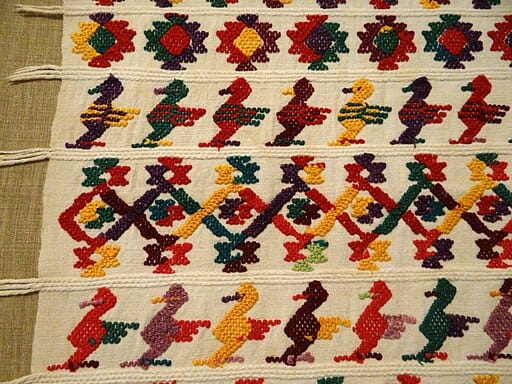
Detail of Indigenous Weaving. Photo by Adam Jones from Kelowna, BC, Canada, CC BY-SA 2.0, via Wikimedia Commons
Your last full day isn’t about gathering. It’s about sitting with what you’ve found.
You walk the route your character would walk — from her home near the market to the church, from the church to the edge of town where the road leads to the valley. You time it. You notice what she’d see at each turn, what she’d smell, where the shade falls and where it doesn’t. You take the walk you’ve been imagining for two years, and you discover that the walk you imagined was wrong — not in the facts, but in the feel. The distances are different. The inclines are different. The way the city sounds from inside it is different from the way you’ve been hearing it in your head.
This is the moment that Doerr described after Saint-Malo, that Chevalier found on her 25-mile hike, that I found in Knoxville when I saw my grandmother’s mill village for the first time. The moment when the imagined place gives way to the real one, and the real one is richer, stranger, more specific, and more human than anything you could have invented.
You go home. You rewrite three chapters.
Let’s be specific about what made this week productive rather than just pleasant.
Advance research. You arrived knowing the historical periods, the major sites, the questions your novel needed answered. Your desk research gave you the framework; the trip filled it with substance.
Local knowledge. A destination management company or local guide connected you with the weaver in Teotitlán, knew the archive hours, recommended the restaurant where the mole was made the traditional way, and got you access to a mezcal producer who doesn’t appear on tourist itineraries. These aren’t things you find on Google.
Structured flexibility. Five of your seven days had a plan. Two didn’t. The balance between intentional research and open-ended wandering produced both the specific details you came for and the unexpected discoveries you didn’t know you needed.
A capture system. Every day ended with thirty minutes of writing — not just what you saw, but what you felt, what surprised you, what challenged your assumptions. Six months from now, these notes will be the difference between vivid prose and vague recollection.
This is what research travel looks like. Not a vacation with a notebook. Not a literary pilgrimage. A working trip, designed around the specific questions your novel is asking, built to produce the sensory and emotional material that turns competent fiction into the kind that makes a reader feel they’ve been there.
If you’re working on a novel and you’ve been putting off the trip — because of cost, or logistics, or the nagging feeling that you should be able to do it all from your desk — I’d love to talk about what your version of this week could look like. It might be Oaxaca. It might be a village in England or a courthouse in Oklahoma. The destination isn’t the point. The method is.
Because the best stories don’t come from Google. They come from showing up.
This is the final post in “The Research Behind the Story.” You can read the full series here:
Trip announcements, curated reading lists, and the occasional dispatch — before anyone else.


.jpg)